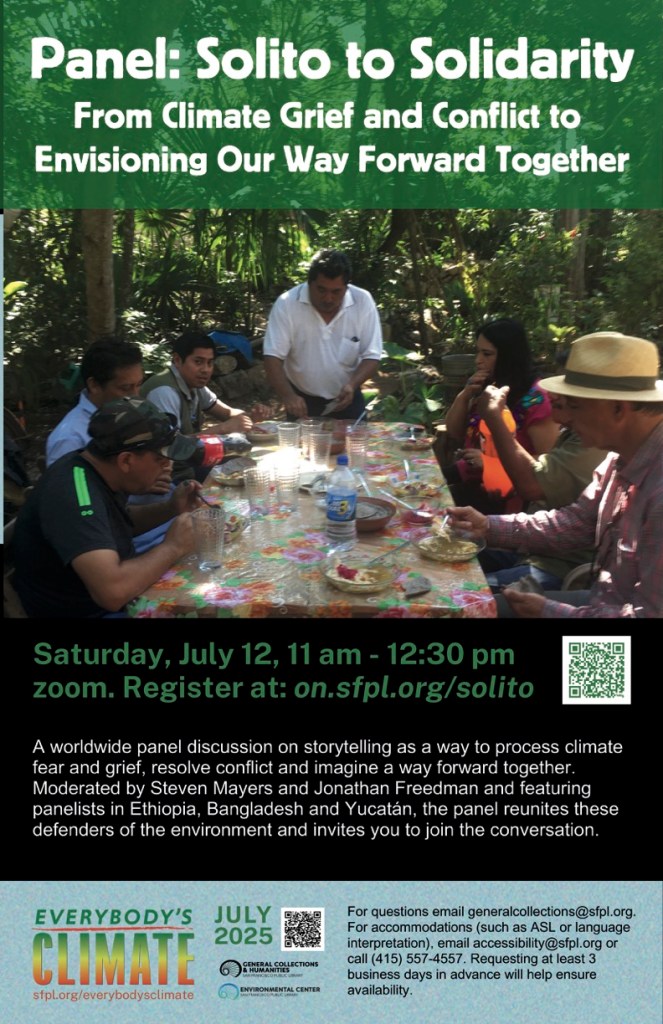
SFPL Panel: Solito to Solidarity – From Climate Grief & Conflict to Envisioning Our Way Forward Together

A worldwide panel discussion on storytelling as a way to process climate fear and grief, resolve conflict and imagine a way forward together. Moderators Steven Mayers and Jonathan Freedman have been on a five-year journey to listen to the stories of people who are searching for creative solutions to climate crises in their regions of the world. Their forthcoming book, Last Chance Road, is an urgent present-tense story documenting their journey to interview individuals on the frontlines of climate change.

Lipi Rahman is one of the founders directly involved in the evolving of Badabon Sangho. She has been supporting the organization with since its inception and is currently acting as Executive Director and General Secretary of Executive Committee. She was born and brought up in an educated Muslim family. She earned a Master’s in Political Science from University of Dhaka.

Mamun Ur Rashid also works with the national women’s rights organisation Badabon Sangho in Bangladesh, advocating for human rights and climate justice. He was born and brought up in the southwest coastal region at the belt of the Bay of Bengal, where people are continuously fighting with climate induced violence and displacement, mobilizing, organizing, and educating vulnerable women, equipping them with tested tools and methods and helping them to be resilient.

Anahí Haizel De la Cruz Martín is a Maya photographer. She was born in Ticul, Yucatán studied high school at the Rodríguez Tamayo Educational Center. In 2018, she participated in a group exhibition Mujeres, Movement and Perspective, on the main trellis of the State Center of Fine Arts of Mérida, Yucatán. She was a fellow of the Young Creators 2019-2020 program of the Fund for Culture and the Arts (FONCA) in the Visual Arts Photography Area. She has published her photographs in the magazines La Ojarasca, Revista Sinfín, in the Italian magazine La Macchina Sognante, as well as in the Mexico News Daily newspaper and the Diario de Yucatán. Haizel accompanies and documents processes of struggle for the vindication of the Mayan language and culture as a member of the Assembly of Defenders of the Maya Múuch ’Xíinbal Territory.

Pedro Uc Be is a poet, teacher, and defender of the Maya land in Yucatan, Mexico. He is a member of the Assembly of Defenders of the Maya Múuch ‘Xíinbal Territory, an organization that aims to defend its territory from the dispossession applied by mega-companies of renewable energy in the Yucatan Peninsula. Pedro is currently a professor at the School of Literary Creation of the State Center of Fine Arts (CEBA), a campus where he also studied.

Seifu Assegid was born and raised in the Eastern part of Ethiopia in Diredawa city. At age six, he lost his father in the Ethio-Somali War. His widowed mother was forced to fell trees to survive. Seifu then went to Cuba at age eight on scholarship as an orphan to study at a government-run primary and junior high school. Seifu returned from Cuba to finish high school with his sister in Tigray, where he witnessed the severe malnutrition crisis there in the ‘80’s. Currently, Seifu works for Save the Children as a Roving Humanitarian Communication Coordinator.

This event is part of San Francisco Public Library’s Summer 2025 series Everybody’s Climate 2025: Connect with others to address the climate crisis in ways that are meaningful to you, from poetry and music to science and practical action. If you wish to view bilingual subtitles, you may click the link below, download the YouTube Bilingual Subtitle extension, and follow the instructions to display subtitles in multiple languages.
Everybody’s Climate 2025, San Francisco Public Library, July 2025

Everybody’s Climate 2025, San Francisco Public Library, July 2025

https://sfpl.org/locations/main-library/general-collections/everybodys-climate-2025

Solito to Solidarity: From climate fear, grief, and conflict to sharing stories and envisioning our way forward together

Saturday July 12, 11am, Zoom

We’ve been on a five-year journey to listen to the stories of people who are searching for creative solutions to climate crises in their regions of the world. Our forthcoming book, Last Chance Road, is an urgent present-tense story documenting our journey to interview individuals on the frontlines of climate change. We take readers along with us to listen to climate-displaced people and defenders of the environment in four remote regions. The interviews are conducted on the ground and via online platforms during the coronavirus pandemic. We’re letting these stories take us where they will, listening rather than prescribing. Last Chance Road leads us to Yucatan, Ethiopia, Bangladesh, back home to California, and converge in Glasgow, Scotland in November of 2021, where the narrators convene at the People’s COP26 to reflect on the global climate crisis, and to envision a shared future. In this panel discussion, we will continue the conversation on storytelling as a way to process climate fear and grief, resolve conflict, and imagine a way forward together.

  • We are Steven Mayers, a professor of English and oral historian, and Jonathan Freedman, a Pulitzer-Prize winning journalist and author. What brought us together was our mutual passion for the human rights of migrants and the power of stories to bring about change. From 2014 to 2019, we joined forces to travel across Mexico and the United States listening to the life stories of young people who had fled extreme poverty, gang violence, and domestic violence in the Northern Triangle of Central America. We collected fifteen of these oral histories in Solito, Solita: Crossing Borders with Youth Refugees from Central America, which is part of the Voice of Witness oral history book series on human rights.
  • Anahí Haizel De la Cruz Martín is a Maya photographer. She was born in Ticul, Yucatán, on July 25, 1993. She studied high school at the Rodríguez Tamayo Educational Center. On March 7, 2018, within the framework of International Women’s Day, she participated in a group exhibition Mujeres, Movement and Perspective, on the main trellis of the State Center of Fine Arts of Mérida, Yucatán. On August 9, she was invited to the collective exhibition The memories of the Mayan Territory at the Museo Maya Santa Cruz Xbáalam Naj in Felipe Carrillo Puerto, Quintana Roo, Mexico. She was a fellow of the Young Creators 2019-2020 program of the Fund for Culture and the Arts (FONCA) in the Visual Arts Photography Area. She has published her photographs in the magazines La Ojarasca, Revista Sinfín, in the Italian magazine La Macchina Sognante, as well as in the Mexico News Daily newspaper and the Diario de Yucatán. Haizel accompanies and documents processes of struggle for the vindication of the Mayan language and culture as a member of the Assembly of Defenders of the Maya Múuch ’Xíinbal Territory. She has shared his photographs on Facebook and on her blog for the outreach of the communities. https://haizeldelacruzm.wixsite.com/misitio.
  • Seifu Assegid was born and raised in the Eastern part of Ethiopia in Diredawa city. At age six, he lost his father in the Ethio-Somali War.  His widowed mother was forced to fell trees to survive. Seifu then went to Cuba at age eight on scholarship as an orphan to study at a government-run primary and junior high school. Seifu returned from Cuba to finish high school with his sister in Tigray, where he witnessed the severe malnutrition crisis there in the ‘80’s. Currently, Seifu works for Save the Children as a Roving Humanitarian Communication Coordinator. Seifu earned a Diploma in environmental Health Science from Gondar College of Medical Science and a BA in Disaster Risk Management and Sustainable Development from Yardstick International University. Seifu’s photographs and stories have appeared in popular television programs, newspapers, and magazines including the UK Daily Telegraph, Aljazeera TV, and media outlets in Australia and elsewhere. He has been voice to the voiceless by sharing their stories for donors and members of Save the Children. His work mainly focuses on people affected by climate change, and is informed by his personal experiences as a child and adult. 
  • Lipi Rahman is one of the founders directly involved in the evolving of Badabon Sangho. She has been supporting organisation with money, labour and suggestion. She has worked as Executive Director of Badabon Sangho since its inception on volunteering basis. Currently she is acting as Executive Director and General Secretary of Executive Committee. She worked with non-profit development sector for last 20 years with different capacities. She was born and brought up in an educated Muslim family. She earned a Master’s in Political Science from University of Dhaka. She has a strong passion and commitment for the vulnerable women. She is single lady, spending most of the time for organisation wellbeing.
  • Mamun Ur Rashid is working with a national women’s rights organisation i.e. ‘Badabon Sangho’ in Bangladesh, working for human rights and climate justice. He was born and brought up in the southwest coastal region at the belt of the Bay of Bengal, where people are continuously fighting with climate induced violence and displacement, mobilizing, organizing, and educating vulnerable women, equipping them with tested tools and methods and helping them to be resilient. This is his day-to-day work.

Latin American Studies Association 2025 Congress

Latin American Studies Association 2025 Congress

Poner el cuerpo en Latinx América

This iteration of the LASA Congress sets out to put the body on the line. To place the body center-stage in order to reveal its weight, relevance, and meaning. To recover its memory and materiality in our debates and agendas; to explore its dimensions at once individual and communal, biological and digital, contingent and situated. Because awakening our skin, opening our eyes and ears, setting our tongues in motion means reading ourselves, understanding ourselves as other(s), and rejecting the petrification of a single way of feeling and thinking. 

Emotional Journeys: A Psycholinguistic Analysis of Youth Migration Narratives

Denis Rey, Steven Mayers, Jonathan Freedman

Sunday May 25, 2025, 3:30 PM, San Francisco Marriott Marquis, 4th Floor, Pacific B

The question that our research aims to address is: How are youth migrants from Central America emotionally affected by their journey through Mexico and into the United States? Much has been written about the psychological and emotional impact of poverty, trauma, and violence on youth migrants, but very little is known about how the journey has directly affected these youth by analyzing the words they use to describe their experiences. With this research, we have a unique opportunity to research this question using interviews of close to two dozen youth migrants in differing stages of their journey. Our research employs Language Inquiry and Word Count (LIWC) software to determine positive and negative emotion, sadness, anxiety, and ideations of death in the voices of youth migrants from Central America’s Northern Triangle (El Salvador, Guatemala, Honduras) who have travelled through Mexico in hopes of reaching and crossing the southern US border. These migrants describe the pull or push factors that motivated their decisions to migrate, the dangerous journey across Mexico, and their experience crossing the border and interacting with Border Patrol officials. Our research allows us to isolate each of these factors to determine their effects on these individuals. We expect to find that the journey across Mexico significantly affects the psychological and emotional well-being of these individuals. The research will shed light on what may be the more traumatizing aspects of the journey as well as who may be more susceptible to the greatest harm and benefit from mental health services.

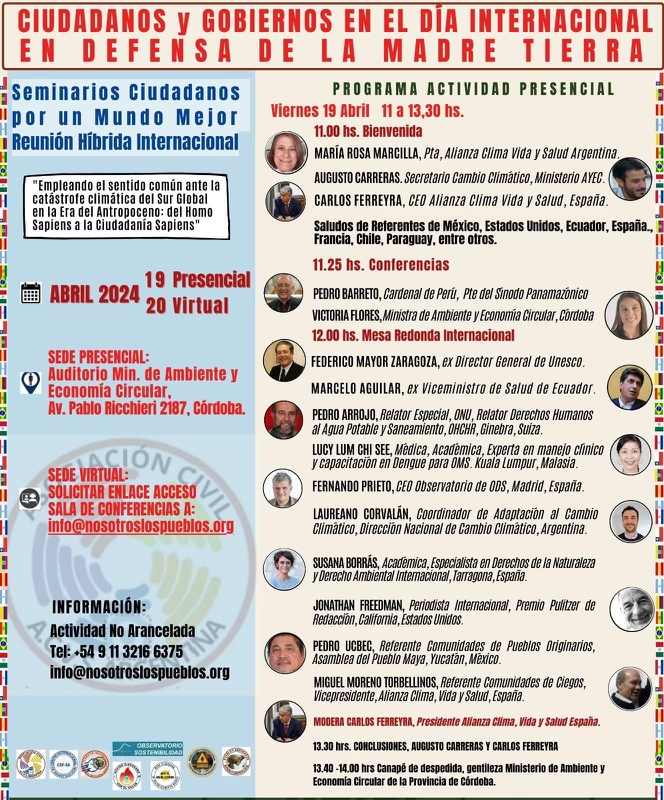
DÍA MUNDIAL DE LA MADRE TIERRA

DÍA MUNDIAL DE LA MADRE TIERRA

SEMINARIOS CIUDADANOS POR UN MUNDO NUEVO

ENLACE DE ACCESO- SEMINAR ZOOM LINK

ALIANZA CLIMA, VIDA Y SALUD ARGENTINA

VIERNES 19 DE ABRIL 2024, 11.00 am Argentina

FRIDAY APRIL 19TH, 2024, 4.00 pm Spain, 07.OO am California, 10.00 pm Malasia, 08.00 am Yucatán, México

PARA ENTRAR A LA REUNIÓN ZOOM PROGRAMADA

Haga doble click sobre este enlace:

https://us02web.zoom.us/j/86714538529?pwd=QTBXN3doQzBVVmZvM3RQNDZlamlNUT09

ID de reunión: 867 1453 8529

Código de acceso: 161636

EVENTO NO ARANCELADO.

Información  WhatsApp: Castellano: +54 9 351 209813 – +54 8 11 34621705; inglés: +54 9 11 32166375   Francés: +34 620 371 867

Howard Zinn Book Fair, 12-3-23!

Last Chance Road: Voices from the Frontlines of Climate Change

Steven Mayers and Jonathan Freedman

Howard Zinn Book Fair

Sunday December 3, 2023, 10:30AM-12PM

CCSF Mission Campus, 1125 Valencia Street, San Francisco, CA

Room 322

Join us in person or on Zoom!

Zoom link: https://tinyurl.com/272zb683

We’re excited to invite you to our upcoming book talk, “Last Chance Road: Voices from the Front Lines of Climate Change.” Our presentation with guest speakers features a “sneak preview” of our challenging four-year journey recording the harrowing and inspiring dozens of first-person accounts of people in four radically different environments: Yucatán, Mexico; Ethiopia, Santa Cruz, and Bangladesh. Their incredible stories bring you deep into Maya heartland, Ethiopia’s droughts/hunger, the wildfires of Santa Cruz, and the rising tides/floods of Bangladesh. Narratives are entwined, geo-synchronously, revealing the challenges people face month to month, year by year, hour by hour with uncertainty, suspense, realism. Our modest global outreach occurred during the COVID lockdown, when we reached out – and people reached back. As far-flung narrators become friends, we share their personal tragedies, hopes and collective dreams of cooperation against a common enemy: passivity and despair of climate inaction. What Can Be Done? Our Dec. 3 presentation happens during COP-28 in Dubai, and two of our narrators – Ibrahim Tchan from Benin, and Lipi Rahman from Bangladesh – hope to join us via Zoom from the climate conference. A third narrator, Seifu Assegid, from Ethiopia, will also join us via Zoom.

We’re asking displaced people the most fundamental human questions: How have they survived? What forces them to leave their homes? What are their journeys like? How are their experiences crossing borders? What is life like where they currently reside? What relief efforts are working? What can we learn from them? And more specifically: How do Maya farmers in Yucatán, Mexico, whose land is being encroached upon by destructive mega-projects protect their territory, their culture, their way of life? How do historically nomadic herders who have been driven by drought to farm in the highlands in Oromia, Ethiopia adapt to overpopulation while trying to maintain their cultural identity? How do firefighters in Santa Cruz County, California, fight the largest wildfire in one hundred years of history while masking up with COVID? How do coastal fishermen and farmers in the Asia Pacific adapt and respond to warming seas, typhoons, and rising sea levels?

We’re seeking wisdom from the displaced, those who come to their aid, as well as those who are fighting for their right to stay home and defend the land. We hope their stories will catalyze questions in readers. Since humans are causing these environmental crises, how can humans work to create change? What kinds of legal, economic, social, moral paradigm shifts would need to take place to ensure human rights are respected? How can we re-envision our relationship with nature?

Maya Women: Life, Art, Hope Contemporary Maya Paintings from Guatemala

Maya Women: Life, Art, Hope
Contemporary Maya Paintings from Guatemala

 
August 25 to December 15, 2023
Featuring: Impressions of the Maya Field, Photographs by Haizel De la Cruz
 
City College of San Francisco, Ocean Campus
Rosenberg Library, 2nd Floor Gallery
50 Frida Kahlo Way
Monday to Thursday 8:00am – 5:00pm, Friday 8:00am – 1:00pm
 
Reception with Maya Dancers & Poets
Thursday, September 14
5:00-7:00 PM

Bay Area Maya Festival, Saturday, September 16th

Bay Area Maya Festival

The Bay Area Maya Festival, a single-day festival on the Mission Campus of CCSF, shares the ancient knowledge and the contemporary concerns of the Maya community. It is the only event in the Bay Area that brings together Maya people across various Maya regions, languages, and traditions. The festival aims to unify people across Maya traditions and educate the community. The festival not only offers workshops on Maya weaving and fashion, but also includes presentations on the Maya calendar and their indigenous world view. Today’s pressing issues will be addressed in workshops on earth healing and immigrant rights. In years past, we have had an estimated audience of 600 Yucatec and Mayan people from throughout the Bay Area.

The festival is scheduled for Saturday, September 16, 2023, from 9AM to 1:30PM, and includes readings by noted poets, writers, professors, as well as a parade of traditional clothing from various Maya villages, an exhibit of Maya art, and workshops on Mayan languages. Festival events are open to community members from young adults to elders. Please see the attached brochure of the 2019 festival for a visual representation of what the festival offers.

SECOLAS conference in Antigua, Guatemala, March 2023

We’re excited to be presenting our paper on a panel at the 70th annual conference of The Southeastern Council of Latin American Studies (SECOLAS) in Antigua, Guatemala in March, 2023!

Bordering Insecurity: How Systemic Violence Affects the Lives of Central American Youth Migrants

Abstract: This study examines the role that structural and pervasive violence plays in the lives of youth migrants fleeing the Northern Triangle. Our research employs comparative case study analysis to better understand the push factors that influence the exodus across Mexico, where, we argue, youth migrants are commoditized by those seeking to profit from their destitution. Once viewed as resources to be exploited, youth migrants suffer worse physical and psychological ruin. For the fortunate who reach American soil, the hardship may diminish somewhat but the distresses remain. The personal narratives that we use in our examination are the voices of those who have made the trek themselves. Our three protagonists – Anderson, Colel, Nuria – provide first-hand accounts of why they decided to migrate and what they encountered along the way. The harrowing, sometimes riveting, portrayals of their experience form the basis of our analysis. We rely heavily on the standards and measures of human security defined by the United Nations Develop Program and others, which we apply to our analysis. This study also utilizes literature on structural violence in efforts to better place youth migration within the context of Sen’s deprivation. Our findings suggest that the lack of human security and the strong prevalence of structural violence push youth migrants from their homes. We learn that during the journey through Mexico the threats associated with structural violence increase greatly. The paper concludes by offering several policy recommendations that aim to reduce the flow of youth migrants from Central America.

Denis Rey, University of Tampa

Steven Mayers, City College of San Francisco, Solito2Solidarity

Jonathan Freedman, Independent Journalist, Solito2Solidarity

Critical Global Citizenship Education Panel Discussion (March 15 at 3:30 pm) at Skyline College

Critical Global Citizenship Education Panel Discussion (March 15 at 3:30 pm) at Skyline College

We are pleased to announce Spring activities as part of our PIF-funded project titled Critical Global Citizenship Education which directly relates to our college’s mission and the People’s College Initiative. The project includes the screening of two documentaries, a panel discussion, and an exhibit.

Panelists discuss ways in which the individual, local, national, and global are interconnected and co-produced, and how each of us can recognize and take responsibility for our choices and actions and thus disrupt global inequities.